

An Osaka native and a regular event organizer in Tokyo, Kazami Ranki is a well-known name on the Japanese shibari circuit.
He founded the Kazami-ryu (風見流), a school that went through a notable period of international expansion in the 2010s, with performances and workshops in North America, Europe and Oceania.
Biography
Kazami Ranki (風見蘭喜) was born on May 23, 1962 (year 37 of the Showa era) in the Kansai region of Japan.
A kinbakushi by profession and president of the SM Circle M group, his career is closely tied to the institution he himself founded: in September 1996, year 8 of the Heisei era, he opened Circle M’s, a space devoted to kinbaku and SM culture that would be the hub of his activity for decades.
His work as a popularizer began in 2000, when he started serializing M’s Monthly Report in Mania Club Magazine and held the first bondage training sessions at Circle M’s. From June 2005 he also published the series Gokuaku tsushin in S&M Sniper magazine.
In 2006 he expanded his teaching, giving classes at Nawa-ya in Tokyo, one of the leading venues of the Japanese scene.
During that same decade he performed regularly at venues such as SM Fetish Bar MISTRESS in Roppongi, Libido, LOFT/PLUS ONE, ARCADIA Tokyo and DX Kabukicho.
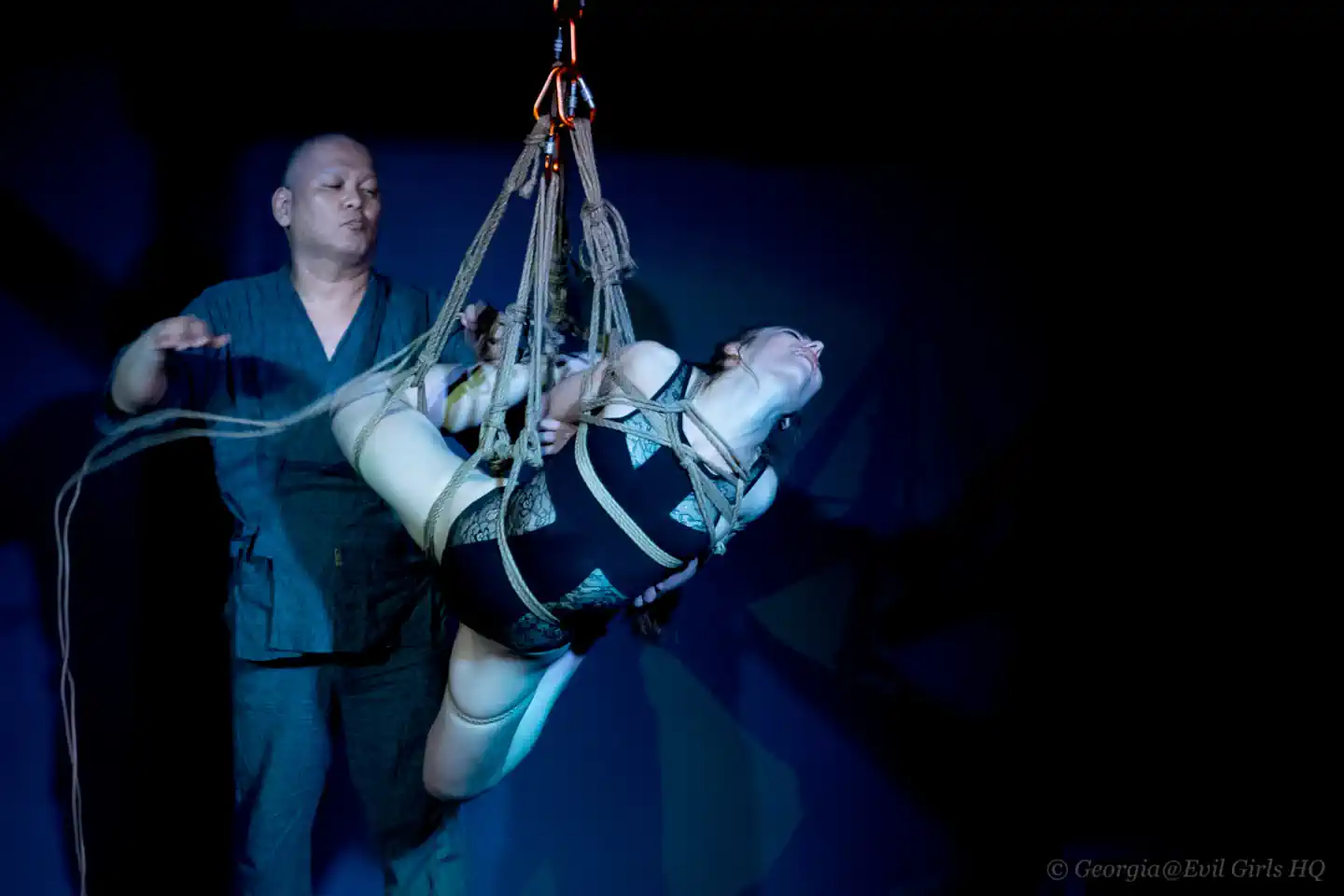
From 2011 his profile became international. Since then he has given workshops and demonstrations in Spain, the United Kingdom, Australia, Canada, France and the United States, taking part in leading events such as The London Festival of the Art of Japanese Bondage, Shibaricon Chicago, Bondage Expo Dallas and the LB Shibari Dojo in Los Angeles, among many others.
In 2016, together with Shigonawa Bingo, he published the manual Ima sugu dekiru! Zusetsu shibarikata manyuaru 2 (いますぐデキる!図説縛り方マニュアル2), and in 2022 (year 4 of the Reiwa era) he took part in Kinbaku Gonin, alongside Himuro Eve, Yagami Ren, Doyama Tesshin and Naka Akira, with the model Shiomi Aya. That same year he published his own beginner’s manual of the Kazami style.
He is recognized for his own style and for his constant dedication to training and promoting new kinbaku artists internationally, work he has carried on without interruption for almost three decades.
His reach abroad, especially in Europe, was probably limited by difficulties in managing his representation.
But Kazami-san—a calm man, always smiling—kept going quietly: performances at venues in Tokyo and Osaka, occasional tours of Asia and Commonwealth countries.
No fuss, no pause.
The Kazami-ryu
The information below is not fully confirmed, but it is what I was able to gather about the ryu’s current members.
In 2025 Kazami Ranki announced Kiko Rope as an official teacher of the Kazami style of kinbaku, thus ensuring the continuity of his school beyond his own figure and recognizing a relationship of learning and collaboration forged over more than a decade.
Kiko Rope (キコ), also known as Mistress Kiko or Mistress You, is a mistress and kinbakushi whose career goes back to the mid-nineties. She began working professionally on the SM scene in 1994, modeling for S&M Sniper, and by 1996 she was performing at the Bizarre Lounge BAR-BARA in Kyoto, where she did much of her early work.
Her interest in kinbaku grew out of a broader fascination with the aesthetics of the corset, and she deepened her knowledge of the discipline under two of her great references: Kazami Ranki and Naka Akira.
That training eventually placed her in an unusual position: that of a real bridge between the Japanese and North American SM scenes.
In 2013 and 2014 she worked as an interpreter for Japanese kinbakushi on Graydancer’s Ropecast, and from 2014 to 2016 she took an active part in workshops and events in North America, coordinating and assisting artists such as Kazami Ranki, Naka Akira and Hajime Kinoko.
Oceania
This is the only group for which the different grades are documented. The region is headed by Miss Gen, with the rank of tokatsu shihan (統括師範), head of the school for Oceania and a direct deshi of Kazami Ranki.
Below her, Basanos holds the rank of shihandai (師範代), instructor and assistant to the tokatsu shihan, and is Miss Gen’s deshi.
At the class instructor level, dojo shihan (道場師範), is Boba_Fit, active in Brisbane with levels 1 and 2.
The rank of certified instructor, nintei shihan (認定師範), is shared by Scarlet in Auckland, Sonx in Christchurch, and Bledig’s Kitten and Bosz, both in Perth, all of them also teaching levels 1 and 2.
Other groups
There is less information about the other formal groups.
They are spread between Southeast Asia—with Rika (彌紗) as instructor and head of the Hong Kong group—and North America, where Canada’s Toronto Kinbaku Salon brings together JD-66, AJ, KJ and other members.
The Kazami-ryu curriculum
The program is structured in four progressive levels. What follows is based on the Australian dojo, the best-documented branch of the school.
Level 1: chest harness fundamentals
The central aim of this level is for the student to be able to apply the standard Kazami-ryu munenawa (chest harness) safely, comfortably and skillfully.
The core program covers the Kazami-ryu munenawa (chest harness or TK), how to tie it and why it is done this way; tensions, why they matter and how to create them in the chest harness; identifying nerve pathways, how to recognize them, tie around them and what to do in an emergency; and safety and emergency procedures. The additional program includes the Kazami-ryu maeniryoute shibari (arms tied in front), the futomomo (ankle tied to hip, no suspension) and the gyaku ebi shibari (floor work, hogtie).
The course consists of 6 classes over 6 months, held on the morning of the second Saturday of each month. Attendance at every class is required to complete the program. The final lesson includes a timed test of the munenawa chest harness: tying a suspension-ready 3-rope harness in 7:30. Practicing at home will be essential to pass it. Make-up classes are occasionally available if a student misses part of the program, and Miss Gen is also available for private lessons.
Level 2: first partial suspensions
Building on level 1, the student begins working on partial suspensions safely, comfortably and skillfully.
The theory raises a fundamental question: why do you tie or get tied? How do you reach that goal? Floor work revolves around maai (間合い): interaction with the model, the positioning of both model and rigger, and the ability to anticipate.
The techniques include the body harness with free arms, the upper kannuki free munenawa (TK), tassuki options on the front of the munenawa (TK), and improvements in flow, speed and tension when tying the munenawa (TK). The partial suspensions cover the koshi nawa (two versions of hip harness) and the chokuritsu ashi shibari (half-mermaid-style leg harness).
As for equipment, the level covers what is used and why: suspension lines and how to tie them, loading the harness, balance, and the physiology or handling of the partner’s movement. The safety block covers effective partner monitoring, managing blood flow and nerves, how to guide the partner safely to the floor, and emergency procedures.
Access to level 3 is not automatic: the instructor must invite the student if they consider them capable. The graduation test requires the suspension-ready 3-rope chest harness in 5:15, with solid, consistent execution of the suspension lines. The time needed depends on each student’s practice; the average is 10 to 12 classes.
Level 3: full suspensions
Only students expressly invited by the instructor reach this level. The work focuses on performing full suspensions safely, comfortably and skillfully. Safety carries even more weight: line management, partner monitoring and injury prevention are the three pillars of the level.
The suspensions in the program are the bridge suspension (free arms), the Kazami style yokozuri (side suspension), the Kazami style hikyakuzuri (“postman/running man” suspension), the sakasazuri (inverted suspension), the gyaku ebi zuri (“inverted shrimp” suspension), the aomukezuri (face-up suspension), the strappado yokozuri (strappado-style side suspension) and the gaikyakuzuri (open-leg suspension).
Students must complete the program to a standard acceptable to the instructor, with an expected minimum of 10 classes. Entry to level 4 is, again, by invitation.
Level 4: advanced suspensions and building concepts
At this level students apply everything learned in the previous levels to perform advanced suspensions with transitions. The qualitative leap, however, is not only technical: the aim is for the student to stop creating “forms” and start developing “concepts.”
The suspensions and techniques include the hishi munenawa (diamond TK harness), the teppou zuri (“rifle tie” suspension), the shin shin sakasatsuri (straight-arm inversion), the kataashi (ankle suspensions), the hineri zuri (twisting suspensions), advanced transitions, and the adaptation of forms and creation of new figures.
The theory goes beyond technique: communication between model and rigger, the philosophy of tying, building a scene and building a performance.
Graduation from level 4 depends entirely on the instructor’s assessment. There is no set moment: it comes when the instructor considers the student ready. In practice, learning never quite ends.
As you can see, it is a system very typical of Japanese shibari in the Heisei era (1989–2019), which adopted a learning model with a progression focused on complexity and suspension. A logical choice, since it was the golden age of club shows and performances.
Its routines followed a pattern common to almost all Japanese shibari shows of the time.
Technically, these are systems built from “trade techniques,” that is, ties used in different crafts or occupations for practical purposes, but with little or no adaptation to the human body.
That lack of adaptation to the human body, to biomechanics in general and to each person’s anatomy is today one of the main risks of learning shibari from tutorials: those who study on their own, without an informed judgment, reproduce ties without knowing why they are done that way or how to adapt them to each body, and expose themselves to avoidable injuries and frustration.
 EN