
Gote (後手) is the generic name of one of the most popular and recognizable forms in shibari.
Every style, every school and every period has its own versions. Depending on the context, we will find it as gote, as takate kote (高手小手) or as kote (小手). These names cover several types of torso harness that serve similar functions. Our glossary has an entry with the meaning of each of these terms.
That popularity has given rise to countless variations and developments. Each has, or rather should have, a technical reason for being beyond aesthetics. That is not always the case, however: often they are modifications added simply so as not to be identical to the original, without adding any function.
To make study easier, and steering clear of purism, we will define some characteristics and create a classification to serve as a working basis.
Gote
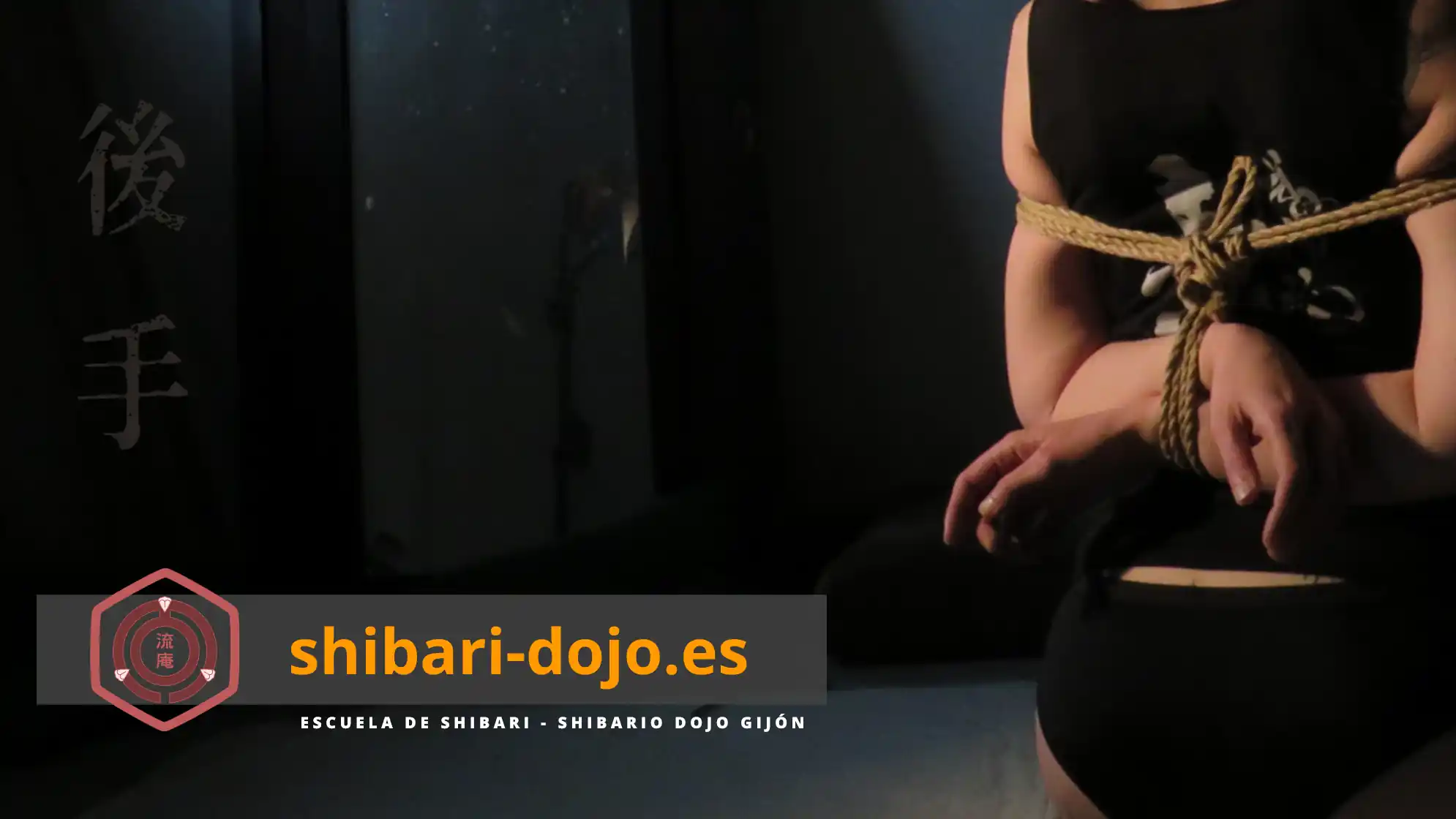
Under this name we group the structurally simplest variants: those that hold the arms behind the body, join them together and have a single line of rope crossing the upper front of the torso.
They are an efficient restraint and, well built, a good tool for managing the body of the person being tied. Because of their simplicity and the way they arrange the body, they create images of great beauty, not without intensity in their apparent calm.
Takate
Also known as TK, the takate is a more complex form. It has two lines, one “above the chest” and one “below the chest,” and is generally a good base for suspensions.
It is a problematic form: poor execution and poor understanding of it have caused countless injuries. Well built, however, with a clear understanding of how it works and in what circumstances and uses it should be applied, it is very functional.
One of the oldest known tying guides for the takate kote was published in Kitan Club in 1961 by the photographer Tsukamoto Tetsuzo, “An Example of a Takatekote Shibari,” as part of his series on the reality of kinbaku photography.
Kote
The similar sound of the two terms means gote and kote are often used interchangeably, but technically they are two different forms.
The basic characteristic of the kote is that it uses the forearms as an anchor point for the ropes. Although, as we will see later, this should be a feature common to all the forms.
Other variants
There are a few more variations of these forms, but because they are of little relevance to erotic shibari practice, we will not cover them.
Different structures
From the point of view of rope technique, there are two broad groups among gote forms.
The first uses counter-tension to close the line or lines that wrap around the body, like those associated with the Naka style.
The second uses locks or “knots” on a central “stem” for the same purpose, keeps a single direction of rotation for the rope and is associated with the styles derived from Akechi Denki.
Between technique and good intentions
The term gote covers a whole range of forms, figures and interpretations. Since it is one of the most popular technical applications in shibari, practically every style and instructor has their own version.
So much diversification can be confusing, complicate both the study and the execution of the form and plunge us into a sea of doubts that are usually resolved by “taking the middle road.”
The problem arises when we lack enough technical grounding to interpret what we are seeing or doing, and we let ourselves be guided by what “seems” right and by good intentions.
Remember the saying: the road to hell is paved with good intentions.
 EN