

A Japanese writer and a fundamental reference in the history and evolution of the SM genre in Japan.
He was born Kuroiwa Yukihiko (黒岩幸彦) on April 16, 1931 (year 6 of the Showa era), before the Second World War, into a family connected to film: his father had wanted to be a screenwriter, his mother had been an actress, and at the time they ran the Kinjokan cinema in Hikone, in Shiga Prefecture (Kansai region, in west-central Japan).
In the 1950s he graduated in law from Kwansei Gakuin University (関西学院大学) in Nishinomiya, near Osaka, where his family had moved in 1943–1944, during the war. He probably learned English from American prisoners of war during that period. In 1955 he started working as a translator for a film magazine in Tokyo, where he settled after finishing his studies.
In his own words, he was drawn to SM from childhood:
I even liked this sort of thing in kindergarten. I remember we had a lovely young teacher of about twenty. More than anything in the world, I wanted to tie her up...
In the second half of the 1950s he earned some recognition for his stories, including second place in the new writers’ prize of the magazine All Yomimono (1957), and in 1958 he published Omachi no saigo (お町の最後), his first contribution to Kitan Club.
In 1962 he published in Kitan Club the first episodes of a serialized story, Flower and Snake (Hana to hebi, 花と蛇), the seed of what would become his most popular work.
That same year he moved to Misaki to teach English and dropped the series after three installments. In 1963, Yoshida Minoru and Tsujimura Takashi went to see him to persuade him to continue. He resumed the series in Kitan Club, signing for the first time as Dan Oniroku, while still teaching and hiding it from his wife.
Over the following years he kept publishing episodes of the series, closing this stage in 1971; in later years new volumes and special series came out with other publishers.
In 1984, Kadokawa Shoten published the first paperback edition of Flower and Snake, in eight volumes, which brought the work to the general public.
A first film version of Flower and Snake appeared in 1965, produced by Yamabe Pro, a company Dan Oniroku had possibly already worked with as a translator and screenwriter.
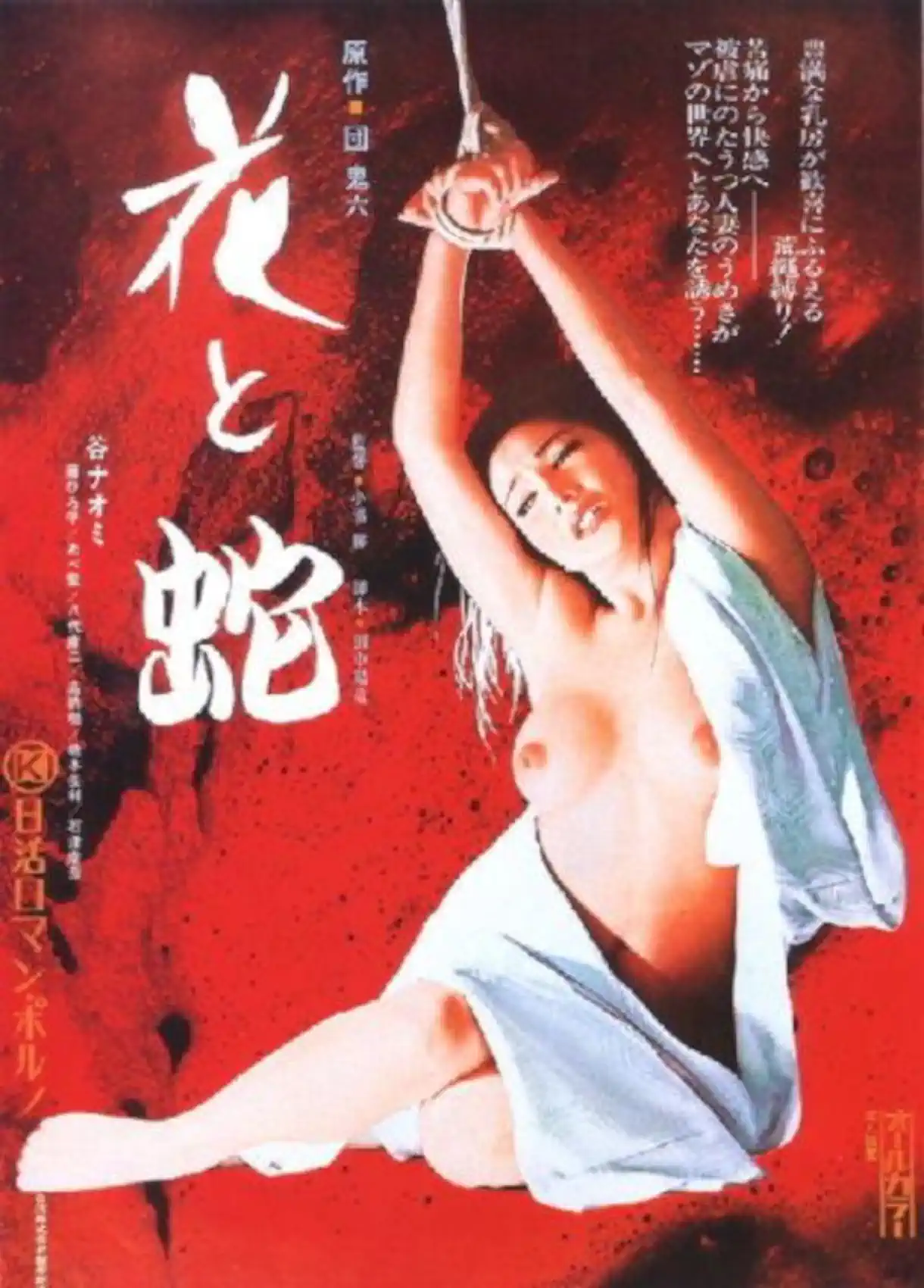
Around 1966 he met the actress Tani Naomi, known as “the queen of SM,” with whom he built a long professional partnership in which their success went hand in hand throughout their careers.
Without doubt, the version that reached the widest popularity and audience was the one produced by Nikkatsu in 1974 (year 49 of the Showa era), which launched a saga of live-action films and several animated ones.
Annoyed by the changes made to his story, he refused to take part in the next film, although he later granted Nikkatsu exclusive rights to his novels. According to Tani Naomi, Dan’s ideal actress had to look good in a kimono, have long black hair and enough body fat for the rope to mark the skin, and stay elegant under the rope. When Tani retired in 1979, Dan said he had been left “in a state of shock.”
According to the director Konuma Masaru, Dan saw three purposes in SM—punishment, confinement and shame—and from him a “Japanese-style” SM was born. The critic Nicholas Bornoff summed it up by saying that Dan had “a gift for making sadism respectable.”
In the second half of the sixties, Dan Oniroku kept writing for various SM titles while working as a screenwriter for film production companies, and in 1969 he founded Oni Pro together with other restless minds.
In 1971 he published Kinbaku taizen (緊縛大全), with photographs by Shinoyama Kishin (篠山紀信).
Oni Pro was made up of artists and creatives from different fields, influenced by the underground culture of the time. Everything suggests that its base was an apartment in Shibuya (Tokyo), where some of its members lived, and its activity focused on producing magazines and films, as well as the occasional live show, always with SM and bondage as the overall theme.
A curious feature of the Japanese performing arts is worth noting here: the tendency to include “humor” in their works. So although the subject matter might make them look like dramas to us, many of their actors are known for their comic side, and a good number of the works include gags and humorous situations in the style of Western “comic operas.” A contemporary example is the performer Otonawa and his club TittyTwisted.
Oni Pro was frantically active for several years until it closed in 1974, the year Nikkatsu released Flower and Snake.
The success and popularity of that production shaped the next decade of Dan Oniroku’s professional life. During the eighties he poured his creativity into every possible medium and wrote some notable works, including two biographies, among them that of Itoh Seiu (Ito Seiu monogatari, 1987).
It was a turbulent period in Japan, and also in Dan Oniroku’s personal and professional life: his second child was born, his father died, he divorced and remarried, he opened and closed both production companies and theaters and moved house, until in 1989 he announced his retirement from professional work.
He then devoted his time to the shogi (将棋) magazine Shogi Journal, which he bought that same year and closed in 1994 with heavy debts.
But he does not seem to have been someone who could stay at home doing nothing, so in the second half of the nineties he returned to work; a highlight of that period is the publication of Shinkenshi Koike Shigeaki (真剣師小池重明, 1995). In January 1995 he created the Oniroku Group within AMS, the SM circle of Nagaike Takeshi, and in 1996 he published the biography of Itoh Seiu Gedo no mure (外道の群れ), adapted for film in 2002 as Oyo (およう), directed by Sekimoto Ikuo and starring Takenaka Naoto. From 1997 he suffered from health problems that would ultimately prove fatal.
In 2004 (year 16 of the Heisei era), the production company Toei released a new version of Flower and Snake (with bondage by Arisue Go), a production that, according to some sources, was not much to the author’s liking.
In 2010 he made his health problems public, and he died on May 6, 2011 (year 23 of the Heisei era).
His funeral was held at Zojo-ji temple (増上寺) in Tokyo, and Tani Naomi delivered one of the eulogies. A year before his death, a selection of his stories had been published in English, Season of Infidelity (2010).
Until his last days he stayed active on his blogs and social media, and he was a reference and a guide for those of us who, like me, were beginning our shibari journey in those years.
His creativity, the quality of his storytelling and his tireless work left a deep mark on the genre and on all of us who, at some point, have enjoyed tying or being tied in forms as beautiful as those Dan Oniroku imagined.
In October 2026, the publisher Great Voyage (大航海) launched a crowdfunding campaign to revive the Dan Oniroku Prize (団鬼六賞) for erotic fiction, fifteen years after its last edition. As early as 1976, the publisher Tokyo Sanseisha had established a first award in his name. The prize, whose first two editions were run by the quarterly magazine Etsu (悦), thus opens its third edition, with a jury made up of the writer Takahashi Genichiro (高橋源一郎) and Hanabusa Kannon (花房観音), winner of the first edition. The winner will be announced in the spring following the close of the campaign.
 EN