

A Japanese bakushi (縛師), he was born in 1930 (year 5 of the Showa era) in Asakusa, Tokyo, and died on September 9, 2013 (year 25 of the Heisei era), at the age of 83. His professional career spanned almost 60 years, during which he took part in the origin, development and spread of what we now understand as shibari kinbaku.
Many years ago, some images caught my attention. Asian women in bondage. But there was something different, something in the aesthetics, in the intensity. Those photos conveyed an emotion and a strong erotic charge that set them apart from all SM pornography.
Over the years I learned that the person behind those images was Nureki Chimuo and that this kind of bondage was called shibari. That was the start of a long journey for me, one I am still immersed in.
Nureki Chimuo arrived on the Japanese shibari scene in the postwar years, contributing to the magazine Kitan Club (奇譚クラブ), edited by Minomura Kou, whose way of interpreting shibari would shape the young Nureki’s first steps and his later development as a rigger.
His real name was Iida Toyokazu (飯田豊一). The pseudonym comes from an old Chinese saying: “a man who chases impossible dreams.” He was the editor of Uramado and wrote for some thirty magazines; according to his own blog, he tied more than 5,000 women over his lifetime.
By then, different ways of understanding and applying shibari could already be seen.
On one side, the circle of masters such as Osada Eikichi or Akechi Denki steered their style toward visual composition, stage narrative and staging, with what we might see as a predominance of technique over inspiration or the fluid expression of the emotional moment.
At the other end, masters such as Minomura, and later Nureki Chimuo himself, geared their style more toward personal, private play than toward display and spectacle.
This approach was shared by major figures such as Dan Oniroku and Yukimura Haruki.
Kinbiken
In 1985 (year 60 of the Showa era), the meetings of “The Sugishita Naomi Club” (杉下なおみの会, Sugishita Naomi no kai) were renamed Kinbiken, the name that brings together Nureki Chimuo’s work as a rigger: first as meetings (rope salons) where he shared and showed his kinbaku and, over time, as the title of a video collection that is now part of the master’s legacy.
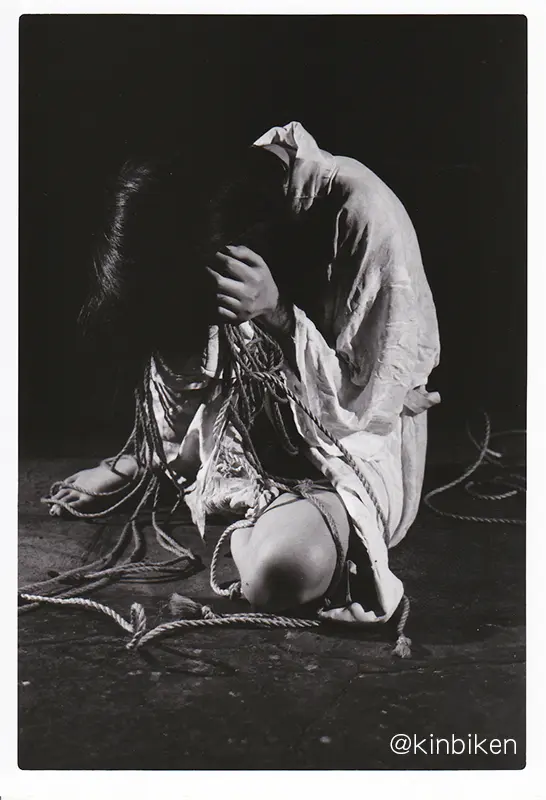
The name is a contraction of Kinbakubi Kenkyukai (緊縛美研究会, “study group on the beauty of kinbaku”), which already hints at its approach.
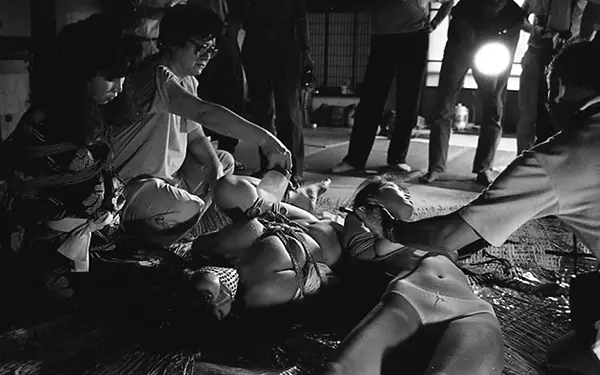
Naka Akira began his training in these salons, which he attended for years as a spectator and occasional assistant before ever touching a rope and deciding to tie someone.
His models were neither professionals nor adult video actresses, but women who enjoyed rope in their private lives, generally masochists. That is why the sessions moved slowly, with pauses to talk and take photographs, looking for what each model could bring. Each tie was built in stages: every addition reinforced the effect, building up not only rope but also an emotional and physical response, a progression that brought beauty and, at the same time, a safety margin.
Within this “style,” the visual result matters less than the effect achieved in the person being tied. And although today it may strike us as somewhat clumsy and limited, at the time it marked a major change in how shibari was understood and practiced, taking it out of the adult industry and into people’s erotic experience.
On public shibari performances and shows, Nureki had a stance he summed up like this:
“I never do shows or live performances. I don’t want to show my kinbaku in front of people who don’t understand what this is about.”
On his blog in 2009 he explained that he had never boiled his hemp rope, because doing so made it “lose its soul and become useless.” He reused it from session to session, each time for harder uses, and when he finally threw it away he said goodbye to it: “You’ve done everything you could. Thank you.”
In 2021 (year 3 of the Reiwa era), the historian Kawahara Azumi published a study of his life and work based on an unpublished interview, in which she corrects some details of his memoirs.
 EN