
Suma Toshiyuki (須磨利之, 1920–1992), known professionally as Minomura Kou (美濃村晃) and also as Kita Reiko (喜多玲子), was a Japanese editor and visual artist and a pioneer of kinbaku.
His work explored the psychological side of shibari, with particular attention to the concept of shuchi (羞恥, shame), and drew a clear, firm line between fantasy and reality in SM.
During the Showa (昭和) era, he played a decisive role in creating the magazines, books and photo studios that laid the foundations of Japanese popular visual culture around bondage and SM.
Biography
A key figure of Japanese shibari and kinbaku, he was born in Kyoto in 1920 (year 9 of the Taisho era, 大正) and spent his childhood and youth in the Showa (昭和) era. His relationship with his mother and his early experiences deeply shaped his vision and his erotic expression through shibari and SM.
After the Second World War he worked for a Kyoto newspaper and, between 1948 and 1953, edited Kitan Club, which he turned into Japan’s first SM magazine. In 1953 he moved to Tokyo to work on Fuzoku Soshi, and in 1956 (year 31 of the Showa era) he founded Uramado as its editor-in-chief.
In the postwar years, Minomura Kou emerged as one of the influential figures in the world of visual eroticism and kinbaku, with a many-sided career that ranged from editing to illustration and photography. He was a pioneer in both publishing and photography throughout the Showa era, when he produced the bulk of his work.
He withdrew from professional life because of health problems at the turn of the seventies into the eighties and died in 1992 (year 4 of the Heisei era).
Publishing: magazines and books
In the postwar period, during the fifties of the Showa era, he established himself as the editor of publications that were key to the development of Japanese SM, such as Kitan Club (奇譚クラブ) and Uramado (裏窓).
In the fifties and sixties, these magazines served as platforms for spreading new forms of eroticism and exploring aggressive aesthetics associated with bondage, influencing both the general public and the emerging underground counterculture.
Minomura also published books of photography and illustration that collected his visual work and explored the philosophical and aesthetic aspects of shibari, with an international impact. In 1953, together with the photographer Tsukamoto Tetsuzo, he published Utsukushiki imashime (美しき縛しめ), known as “the black book”: the first artistic bondage photo album published in Japan, in a print run of only 500 copies.
Photography and film
Under the pseudonym Kita Reiko, he used photography and drawing to portray kinbaku from an emotional rather than a spectacular perspective.
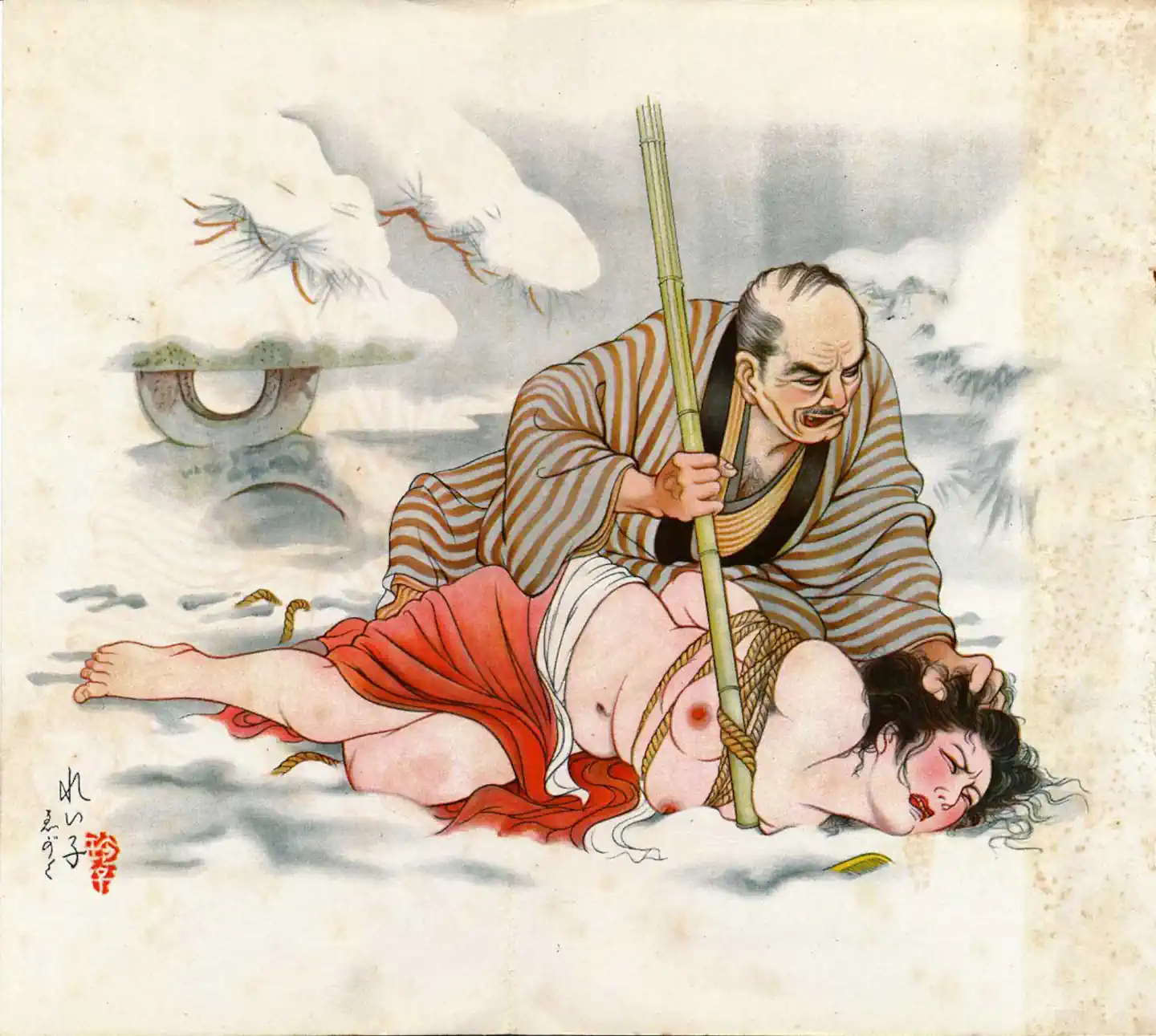
This distinctive approach shows in his work. Technically, he used only five ropes. His positions and sessions sought to evoke shuchi (shame or shyness) in his models, eroticizing that feeling rather than focusing on visual spectacle. Despite the rise of suspensions in the last decades of the Showa era, he rejected the technique entirely and never depicted it in his work. This rejection reflected his preference for a more controlled, psychological use of technique, always mindful of his models’ comfort and well-being.
In 1989, Yukimura Haruki directed Jouen: The World of Minomura Kou, which looked back on forty years of his career alongside figures such as Nureki Chimuo, Dan Oniroku, Muku Yoji and Arisue Go, and in which he can be seen tying. From September 4 to 17, 2024, Tokyo’s Vanilla Gallery held a retrospective exhibition of his work.
 EN